The Problem with "We Only Use X"
I have worked with agencies that only build in WordPress. Others that swear by Webflow. Some that will only touch React. And while specialization has its place, I have seen it cause real problems for clients:
- A startup forced into a WordPress site when they needed a custom web app
- An e-commerce brand stuck on a no-code platform that could not handle their inventory logic
- A marketing team paying enterprise prices for a simple landing page because the agency only worked with expensive frameworks
The common thread? The agency chose the tool before understanding the problem.
What "Framework-Agnostic" Actually Means
Being framework-agnostic does not mean we use everything and master nothing. It means we start with the problem, not the solution.
Here is our decision process at The Boring Solutions:
Step 1: Understand the Goal
What does the client actually need? A marketing site? A web app? An e-commerce store? A blog? Each of these has fundamentally different requirements.
Step 2: Consider the Constraints
- Budget: A $2,000 project and a $20,000 project need different approaches
- Timeline: Need it in two weeks? That changes the tooling
- Maintenance: Who will update this after launch?
- Scale: Will this serve 100 users or 100,000?
Step 3: Pick the Right Tool
| Need | Tool | Why |
|---|---|---|
| Marketing site | Webflow | Fast to build, easy for clients to edit |
| Blog or content site | WordPress | Mature ecosystem, SEO-friendly |
| Web application | Next.js | Full control, scalable, modern |
| Quick landing page | Webflow or HTML | No need to over-engineer |
| AI-powered tool | Next.js + API | Need server-side logic |
Real Examples
Client A came to us wanting "a React website." After talking through their needs, we realized they needed a marketing site with a blog. We built it in Webflow: half the cost, half the timeline, and the marketing team can update it themselves.
Client B had a WordPress site that was falling apart under custom plugin spaghetti. We rebuilt the core features as a Next.js app with a proper API, keeping WordPress as a headless CMS for content. Best of both worlds.
Client C needed a simple portfolio. Instead of spinning up a full framework, we used a clean HTML/CSS template with minimal JavaScript. It loads in under a second and costs nothing to host.
The AI Advantage
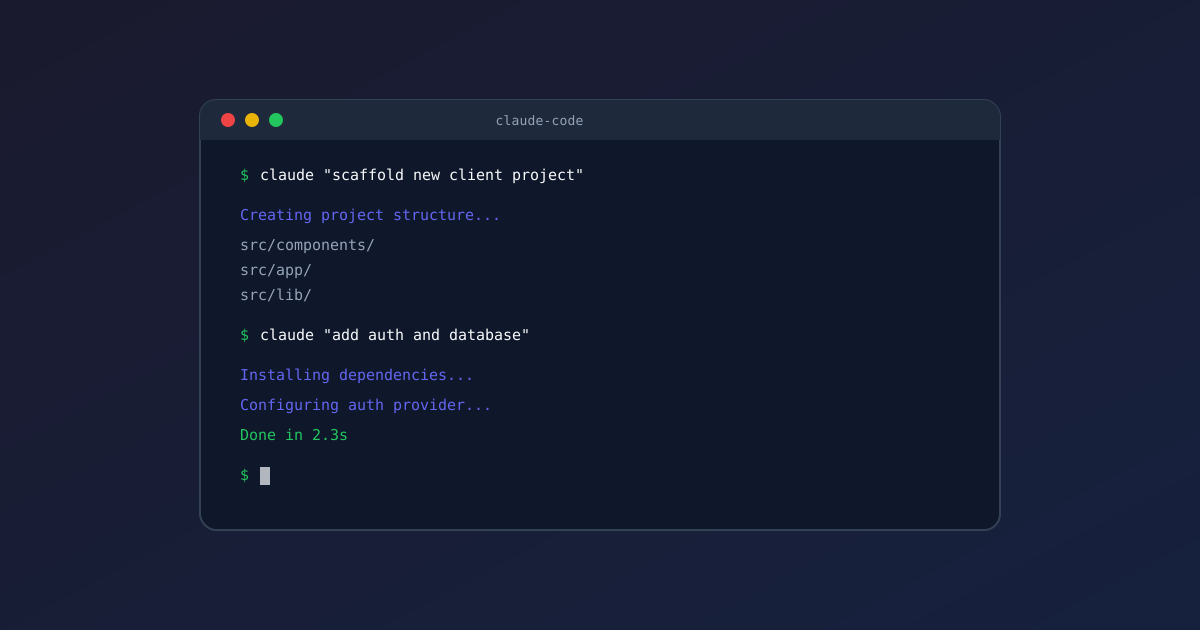
Being framework-agnostic becomes even more powerful with AI tools like Claude. Because I work across multiple platforms, I can use Claude to:
- Scaffold a Next.js project in the morning
- Debug a WordPress plugin in the afternoon
- Optimize a Webflow site's SEO before end of day
Claude does not care what framework you use. It adapts, and so do we.
The Bottom Line
The best framework is the one that solves the problem. Not the one that is trending on Twitter. Not the one your agency happens to specialize in. Not the one with the most GitHub stars.
If you are evaluating agencies or developers for your next project, ask them this: "Why this stack?" If the answer is "because it is what we use," keep looking.
The right answer should always start with your goals.